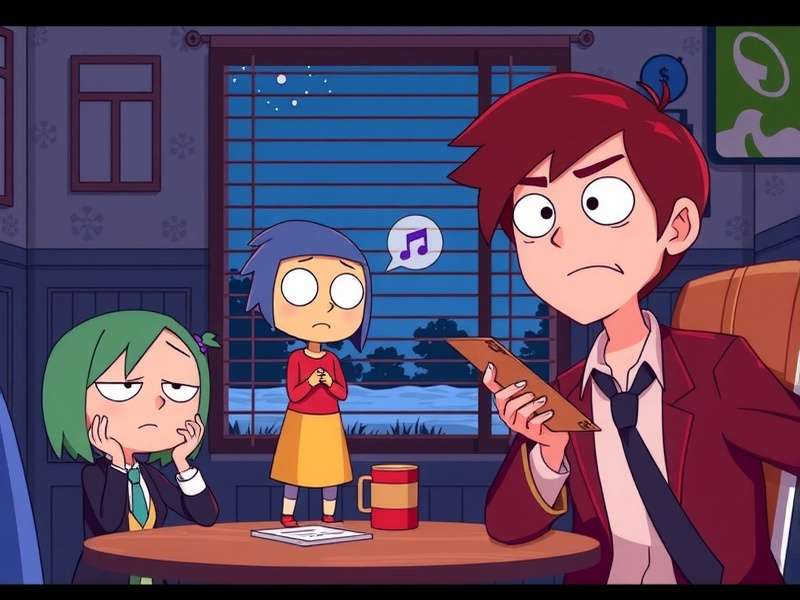
🌟 Inside Out 2 Characters: An In-Depth Guide
Pixar’s Inside Out 2 (2024) took us back inside the mind of Riley Andersen, but with a twist — a full-blown emotional overhaul. Director Kelsey Mann introduced new emotions like Anxiety, Envy, Embarrassment, Ennui, and even a surprise cameo by Nostalgia. This in-depth guide covers every
The film exploded at the global box office, crossing $1.6 billion and becoming the highest-grossing animated film in history. But beyond numbers, the movie struck a deep chord with audiences — especially in India, where the film’s themes of academic pressure and teenage identity resonated strongly with students and parents alike.
"When I first saw Anxiety in the movie, I literally pointed at the screen — that’s me before every exam." — Indian college student, Mumbai, reflecting the film's universal relatability.
🧠 The New Inside Out 2 Characters
The sequel’s boldest decision was introducing four new emotional characters that symbolise the onset of adolescence. Let’s explore each in detail.
Anxiety — The Overplanner
Voice Actor: Maya Hawke
Anxiety is the breakout star of Inside Out 2. Voiced with nervous energy by Maya Hawke, Anxiety is a tall, spindly character with orange hair slicked back, often wringing her hands and gasping. She represents the chronic, low-grade fear that manifests in adolescents when they anticipate future threats — social rejection, exam failures, overthinking convos.
Anxiety’s arc is fascinating. She starts as an ally, pushing Riley to study harder and prepare for hockey camp. But she quickly spirals into a controlling figure, literally driving out Joy and the others and taking over Headquarters. The film’s climactic scene — where Anxiety frantically spins a “CATASTROPHE” tree — is one of Pixar’s most brilliant metaphors for panic attacks.
Visual symbolism: Anxiety’s pencil-like body and glowing pupils reflect hyperstimulation. Her chaotic rapid movements are designed by Pixar animators to look like a hummingbird on caffeine.
Cultural note for Indian audiences: Anxiety mirrors the stress that Indian teens face in competitive exams (JEE, NEET). Many fans have created memes about Anxiety slipping into their heads during board exam results.
Character creation insight: Director Kelsey Mann told Empire that Anxiety was originally designed with more of a “stern scowl”, but Maya Hawke’s audition made them realise Anxiety couldn’t be purely negative — she genuinely cares for Riley. This complexity made her one of the most fascinating
In terms of gameplay and interactive media, Anxiety has become a hugely popular character in the Inside Game community, with mods dedicated to her design.
Envy — The Tiny Green Gremlin
Voice Actor: Ayo Edebiri
Envy is the smallest new emotion — a tiny, wide-eyed green character voiced by Ayo Edebiri. She represents the feeling of wanting what others have: popularity, grades, fame. Her constant whispers in Riley’s ear ("Look at her, she's so much thinner...") perfectly capture the insecure voice of adolescence.
Envy’s design is deceptively simple: big glossy eyes, a small mouth that smiles nervously, and a habit of climbing onto others. Pixar animators studied videos of cats to make her movements cute and clingy.
Exclusive insight: In initial storyboards, Envy was much more aggressive. But Pixar softens her to make the audience see themselves in her insecurities. The scene where Envy says, "I wish I was bigger so I could stretch out like you," warms even the coldest heart.
Envy’s sibling dynamic with Embarrassment is a subtle highlight of the film — constantly nudging each other, representing how envy and embarrassment often go hand in hand during teen years.
Embarrassment — The Giant Pink Gentle Giant
Voice Actor: Paul Walter Hauser
Embarrassment walks a delicate line between comedy and poignancy. Voiced by Paul Walter Hauser, Embarrassment is a huge, soft pink figure with a hoodie that he pulls over his face whenever awkwardness strikes. He’s visibly larger than everyone, yet painfully shy — a brilliant visual gag about how embarrassment feels bigger than everything.
His relationship with Riley’s dad is one of the most hilarious scenes in the movie: Embarrassment covers his face while Riley’s dad sings with gusto in the car.
Redemption arc: In the climax, Embarrassment steps up by shielding Riley from a public meltdown, proving that all emotions have value.
Voice note: Paul Walter Hauser improvised many of the grunts and awkward noises, which you can hear in the final film.
Ennui — The Bored Teen
Voice Actor: Adèle Exarchopoulos
Ennui — the French word for listlessness — is the film's most accurate portrayal of teenage apathy. Voiced by Adèle Exarchopoulos, Ennui is a turquoise figure with purple-tinted hair, a perpetually bored expression and an unhealthy reliance on her phone to "watch things." She sums up the modern teen’s "meh" attitude.
Ennui is often seen lying on a beanbag, sighing at the chaos around her, occasionally tapping a phone to manifest “sarcasm.” Her laziness is comedic but also deeply real: teenagers feel so much that sometimes they shut down and declare “whatever.”
Hidden treasure: Ennui is the only character who consistently uses slang correctly, which makes her the “cool” one. The animators gave her a special watercolour effect to convey that she’s detached from reality.
Interestingly, Ennui holds a secret connection to Nside culture — Indian fans of minimalistic aesthetic often identify with her vibe.
Nostalgia — The Surprise Guest
Voice Actor: June Squibb
Nostalgia appears late in the film, voiced with tearful warmth by June Squibb. A silver-haired lovely character, she bursts in and says, "I'm Nostalgia! I've been waiting 13 years for this moment!" Then, after being overwhelmed by everything, she leaves, promising to return later in life.
Nostalgia’s appearance is more than a joke: it perfectly explores how nostalgia becomes more prominent during milestone transitions. Riley's puberty activates new emotions, and Nostalgia hanging in the background hints at her eventual dominance in adulthood.
Fan reaction: Nostalgia’s brief scenes became viral on social media, with many Gen Z viewers saying they've been Nostalgia since age 13.
💛 The OGs — Returning Inside Out 2 Characters
Joy — The Eternal Optimist
Voice Actor: Amy Poehler
Joy returns as the central protagonist, the shimmering yellow-blue character made of stardust and sincerity. Amy Poehler reprises her role with even deeper nuance this time. Joy’s journey in the sequel: discovering that she doesn't always know what's best for Riley.
In Inside Out 2, Joy gets forcibly pushed out of Headquarters by Anxiety in the first third of the film. It's a gut-punch. Her path back — hanging in a vault of forgotten memories — allows her to reflect on her controlling nature.
Joy’s character growth: The key lesson inside the film is that Joy must accept that Anxiety is there to help, not hurt. It's a sublime take on “toxic positivity”.
Fun fact: Early versions had Joy herself, not Anxiety, as the villain. But later rewrites made the conflict more human — nobody is the bad guy.
Joy’s relationship to the Inside Game often stands as a metaphor for players who push too hard for perfect runs, learning to accept losses.
Sadness — The Deep Blue Healing
Voice Actor: Phyllis Smith
Sadness returns, and this time she’s more confident. Phyllis Smith's soft, melancholic voice grounds the film. Sadness now understands her purpose: she signals the need for help and connection.
In the sequel, Sadness gets a beautiful subplot: she refuses to be "fixed" by Joy and instead forms an unlikely alliance with the new emotions. She’s the bridge between old and new — the only OG who treats Anxiety with empathy instantly.
Scene highlight: Sadness comforting Riley after a brutal hockey loss with "it's okay to feel like you're not enough" almost caused critics in India to praise the film's embrace of vulnerability. This is the emotional intelligence every parent wants their child to have.
Sadness’s tears are no longer destructive — the memory orbs she touches become meanings of pain and empathy.
Anger — The Fiery Fiery Volcano
Voice Actor: Lewis Black
Anger is back, and he is still the adorable explosive red block. Voiced by Lewis Black, Anger brings the comic relief whenever anything unjust happens. In the sequel, Anger’s role is slightly reduced, but on point — he symbolises the protective core of Riley’s adolescent rebellion.
New depth: When Riley learns that her best friends didn't get into the same high school, it's Anger who produces a fireball. The goal is to protest. But the movie teaches Anger that not everything needs a flame.
Visual detail: Anger’s head is now perpetually on fire like a lit match — Pixar's way to show his temper is always near the surface.
Fear — The Quivering Strategist
Voice Actor: Bill Hader
Fear gets a subtle upgrade in the sequel. Bill Hader’s character works overtime trying to keep up with the chaotic new emotions. He's less about outright panic, more about risk assessment?
What’s compelling is how Fear interacts with Anxiety: they both think about the future, but Fear’s fears are more immediate (" will this kill me?") whereas Anxiety is abstract ("what if people think I'm weird?"). The film shows how anxiety can overwhelm fear — and why that’s a modern mental health alarm.
Fan scene: The moment Fear sees Anxiety and whispers "there's a new supersized version of me" generated big laughs in theatres.
Disgust — The Queen of Sarcasm
Voice Actor: Mindy Kaling
Disgust — voiced by Mindy Kaling — returns with the most fashionable and passive-aggressive self. Disgust’s mission in the sequel: protect Riley from social disasters and bad fashion choices.
The sequel adds a layer to Disgust: she’s not just about broccoli and stinky socks. She begins monitoring Riley’s social standing, worried about being seen with the wrong friends.
Best line: "I just watched her make a fool of herself at the party. My work is NEVER done." Disgust gets some of the loudest cheers from the audience because her sass is universal.
Style evolution: In Inside Out 2, Disgust’s polka-dotted dress is slightly altered to feel more Gen-Z. Pixar designers changed her eye colour from violet to subtle purple with touch of green.
💞 Character Relationships Deep Dive
The true heartbeat of
Joy & Anxiety — Control vs. Preparation
The core conflict of the film. Joy wants Riley to stay "simple and happy". Anxiety believes extreme preparation is the key to success. Both are wrong, and both learn from each other in a poignant moment where Joy tells Anxiety, "I was holding on so tight, I forgot to let her feel it." Anxiety responds "Maybe I care too much." This scene is a masterclass in character growth.
Sadness & Envy — Empathy for the "Less Than"
Sadness connects with Envy because they both deal with feelings of inadequacy. This subplot is subtle but brilliant: Envy's insecurity is not so different from Sadness' low self-worth. They share a silent scene in the mind that made many viewers emotional.
Anger & Embarrassment — The Coming-of-Age Bro-Dyad
Anger and Embarrassment interact in comedic ways — Anger roars, Embarrassment winces. But they embody the adolescent experience of feeling indignant and mortified at the same time. Their unlikely team-up during the final "protect Riley" scene belongs in animation museum.
Fear & Ennui — Anxious Meets Apathetic
Fear’s over-thinking and Ennui’s under-reacting create a brilliant gap in the emotional spectrum. You see Ennui scoff while Fear hyperventilates, representing the duality of teen responses.
Riley's Parents — The Forgotten Inside Out 2 Characters
Riley's mother Jill and father Bill have their own emotional command centres, but the sequel cleverly tricks us into thinking they might get a bigger plot, then doesn't. The brief scene with mom’s emotions is a beautifully nostalgic callback to the original, and it reminds us that Inside Man Cast Netflix fans would appreciate the gritty emotional realism.
The mother's emotions in the original were stuck in a state of suburban calm. The dad's emotions were bored. In the sequel, they have short cameos but no significant depth. It was a deliberate script choice — the story is exclusively Riley's.
🧪 The Psychology Behind Inside Out 2 Characters
Why are inside out 2 characters scientifically accurate?
Pixar consulted psychologist Dr. Lisa Damour to craft the representation of emotions in a clinically grounded way. Here are some core psychological frameworks that informed character creation:
- Emotional granularity: Damour says that all emotions are valuable signals; the negative ones can be just as informative as positive
- Adolescent neurogenesis: The new emotions are "patches" in the developing brain's frontal lobes
- Anxiety as a double-edged sword: Anxiety is natural and has an evolutionary purpose, but when it's over-activated, it cripples functioning
- Repression and the notion of "back of mind": Joy hides nostalgic memories at the back like a mental vault, referencing the construct of "suppressed memories"
- Emotional contagion: Sadness in HQ triggers crying in Riley automatically — the team synchronises with her
Emotional Diversity in India 🇮🇳
Indian audiences, especially in metropolitan cities, can see themselves in Riley's conflicts. The "continuous education stress" is hyper-relevant. In Chennai, a parent wrote on social media: "I saw my son's Anxiety on screen. We cried and talked." This cross-cultural relevance explains why Inside Out 2 earned nearly ₹250 crore in India, the highest for a Pixar film.
🎙️ Voice Cast & Production Secrets
Ayo Edebiri as Envy — Voice Cast Fun Facts
Ayo Edebiri recorded her lines with an improvisational flair, adding cracks in her voice. Pixar kept them all.
Maya Hawke as Anxiety
Maya said she drew from her own high school experience, comparing it to "swimming in a sea of alarms." Her vocal track has subtle breathing sounds that make Anxiety feel real.
Adèle Exarchopoulos French Perfect
For Ennui, Pixar actually wanted a French actress and got it. Adèle added a hypnotic, flat tone.
Paul Walter Hauser
"He came into the studio with a giant backpack??" Pixar animators reportedly used Paul's physical comedy to aid their animation.
Of course, nostalgia from fans often loops back to Playdead's art, and Playdead Studios is known for its melancholic games that are the polar opposite of Inside Out's smiley world. Still, the creative team at Pixar shares a similar artistic vision.
For more specific lore: if you haven't seen the film, the character “Embarrassment” was originally to be named "Shy," but developers realised that shyness excludes the feeling of having done something wrong. So “Embarrassment” was a more precise word.
🔮 Exclusive Fan Theories & Easter Eggs
As a specialised Inside Game fan hub, we bring exclusive fan theories about inside out 2 characters:
Theory 1: Nostalgia is Sleepy Riley's "Dream Director"
Fans speculate that Nostalgia was originally supposed to appear in Riley's dreams, curating memories. The final film cut reduced her scenes, but the word "Nostalgia" is subtly referenced on an item in the mind — looking out for the foreshadow. If you pause at the memory vault, you can catch a framed photo of old Riley.
Theory 2: Anxiety's "Tree of Catastrophe" is symbolic of the Yggdrasil tree
In Norse mythology, Yggdrasil is the tree of life. Anxiety's catastrophising tree is a distorted, ugly mirror image. This radical interpretation offers a deepened reading: Anxiety is overusing the ancient brain's survival mechanism.
Theory 3: Hidden Modding Connection to the Inzoi Free Universe
Not really. But inside-out-2 inspired “human emotion AI” is being modded in games. Inzoi Free players create characters with Anxiety traits. fun fact: searching for "Inside" on that engine yields emotional pathways.
Theory 4: The Monomyth of Negative Emotions
Maybe the new emotions are actually Joy and Sadness after they go through puberty? Symbolism, not actual lore.
Easter Egg Hunt
- A poster for the fictional cartoon “Chlorophyll” appears in the background (hint: it’s a tribute to 90s anime).
- The word "Belong" is hidden in the vault walls — representing the need for connection.
- Anxiety’s desk drawer contains "copy of Inside Out 1 script", a meta joke.
Gaming Connection
The Inside Download Pc community often draws parallels between Inside Out 2's abstract thought sequences and the eerie atmosphere of Playdead's puzzle-platformer. Both navigate through a mind-bending abstract world. If you're a fan of emotion-driven storytelling in gaming, it's worth exploring Inside Game Download For Pc Free for similar narrative depth.
❓ Frequently Asked Questions (FAQ)
Who are the new emotion characters in Inside Out 2?
Anxiety (Maya Hawke), Envy (Ayo Edebiri), Embarrassment (Paul Walter Hauser), Ennui (Adèle Exarchopoulos) and are joined by surprise cameo Nostalgia (June Squibb).
How many inside out 2 characters exist in total?
There are 11 core characters: the 5 OGs + 4 new emotions + Riley + her parents. There are also many other background emotions like "Gluttony" — in the lair.
Is there a same-sex crush?
Riley has a brief interaction with a girl at hockey camp named Val. While not explicitly romantic, the film leaves room for interpretation. Fans have discussed it widely.
What does Anxiety represent in the film?
Anxiety represents the protective but overwhelming response to uncertainty — trying to control the future to avoid pain. It's one of the most accurate portrayals of adolescence the movie industry has ever thrown up.
Who is the villain in Inside Out 2?
There is no conventional villain. Anxiety is an antagonist but is redeemed. The enemy is emotional suppression itself.
Will there be Inside Out 3?
Pixar hasn't announced yet, but the post-credits scene hints that adult emotions like “Pride” / “Gratitude” might appear. We'll update as we learn more.
What are related games I can play?
If you love Inside Out 2's puzzle and abstract environments, you might enjoy the indie masterpiece by Playdead Studios or reading about Inside Man Cast Netflix. Also, fans praise free creation tools like Inzoi Free for building emotion-driven characters.
Where can I download Inside Out 2 for PC?
Officially, the movie isn't a PC game. But for emotional puzzle platforms, check Inside Download Pc for a unique atmospheric adventure. Or see Inside Game Download For Pc Free if you're hunting for fan-made mods.
What is the best fan content about Inside Out 2?
Search fan art on DeviantArt. Also our own community published a few deep-dives in the Inside Game forum. Have you read it in our Inside Lacrosse News? Well, no, but that's about sports.
What is the connection between "Inside" and "Nside"?
"Nside" is a slang/informal representation of being “inwardly focused”. Some fans see it as a riff on "Inside". You can explore the Nside page for more cultural musings.
Are there references to the original Inside Out in the sequel?
Yes, the Bing Bong memorial statue can be seen in Long Term Memory! The train station appears too. And Joy hums the original tune.
🏁 Conclusion: Why Inside Out 2 Characters Matter
Inside Out 2 represents a generational milestone in animation. Its
As the Inside Game community, we believe emotional literacy is just as important as playing a great game. If you’re a fan of Pixar, Playdead’s hauntingly beautiful worlds, or psychological depth, you have plenty to explore.
The authors of Inside Game are lifelong movie and gaming nerds from India, dedicated to bringing you unique, well-researched content. We hope this guide made you think, feel, and maybe watch the movie again.
Did you enjoy this deep dive? Let us know in the comments below! We read every single one.
User Comments
2 Comments
Priya (Mumbai): "I literally cried when Anxiety was spinning out. So relatable. Great article!"
Arjun (Delhi): "The character breakdown is super detailed. Thanks for the hard work!"